- Fellow Highlights
Q&A: MD/PHD Student Akshay Swaminathan Looks Back At The Fellowship
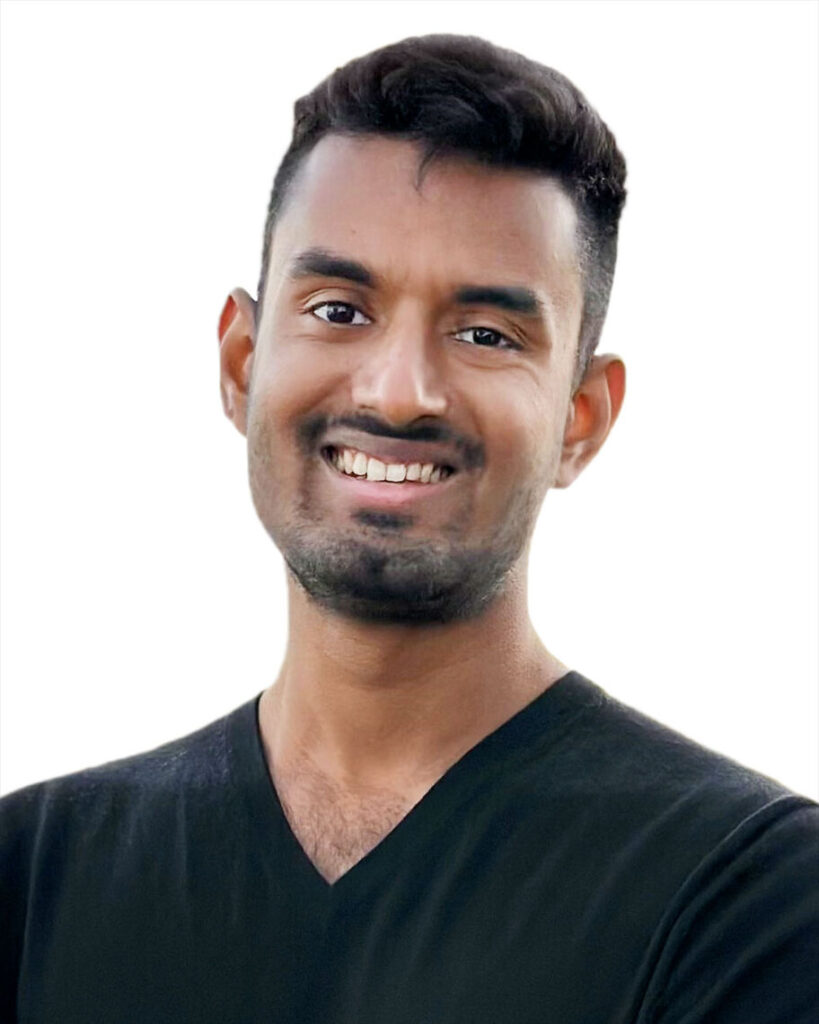
Akshay Swaminathan is a 2024 Paul & Daisy Soros Fellow and the child of immigrants from India. Raised in Wood-Ridge, New Jersey, Akshay inherited a deep connection to his cultural roots through learning Carnatic music. His experiences learning Indian music and language taught him the importance of overcoming generational, linguistic, and social barriers to connect with others, fostering a lifelong passion to serve diverse communities through global health initiatives and language learning platforms.
Akshay became captivated by data science and medicine because of their power to strengthen health systems in low-resource areas and safely deliver healthcare. While studying at Harvard College, he pursued his passion for real-world deployment by publishing over 40 quantitative papers, directing a nonprofit that built a primary healthcare clinic in Bolivia, and deploying a patient safety system serving over 500,000 people. A Knight-Hennessy Scholar, Akshay is pursuing an MD and a PhD in biomedical data science at Stanford University.
You are the child of immigrants; how has that experience shaped the questions you ask in your work or the way you move through the world?
Being the child of immigrants means I am constantly thinking back to my parents’, grandparents’, and great grandparents’ generations and their opportunities (or lack thereof) to achieve their full potential. You don’t have to go too far back in my family’s history to find people who died in infancy, who were married as young children, who didn’t complete high school, etc. That motivates me to work towards a world where everyone has an opportunity to reach their full potential.
What question or problem is at the center of your work right now? How would you explain it to someone outside your field?
The biggest problem in global health is not a lack of effective treatments, it’s poor distribution. Making treatments that save lives in North America accessible to poor families in rural India or Sub-Saharan Africa is the defining challenge of global health.
How has your thinking about your work evolved over the past two years? What are you asking now that you weren’t asking when you started?
I have realized the importance of leaning into my “superpowers” as a way to create outsized impact. Through experiences that have pushed me outside of my comfort zone, I’ve understood what I’m okay at, what I’m good at, and what I’m unreasonably good at. That last bucket—the things that come effortlessly and naturally to me—are my superpowers. I am constantly asking myself, how can I spend less time on the things I’m ok/good at, and more time on the things I am unreasonably good at?
What’s a friendship or connection from the PD Soros Fellowship that has meant something to you?
One of my closest mentors is a PD Soros Fellow about 10 years older than me. Over the years, he has been a special source of inspiration, motivation, and encouragement. On a professional level, he’s helped me get two full time jobs which have been trajectory-altering roles that I likely would not have had access to otherwise. On a personal level, I leave each one of our conversations feeling energized and hopeful for the future and my role in shaping it.
Is there a problem in the world you most want to contribute to solving? What gives you hope that it’s solvable?
In much of the world, there simply are not enough healthcare professionals. I believe technology has the potential to level the playing field. I’ve spent the last five years building and deploying patient- and clinician-facing systems to deliver high quality healthcare in low resource settings. I can see a future where everyone on earth has access to high quality healthcare, and I think our generation has a great shot of making that happen in our lifetimes.
Keep Exploring
-
 Read more: PD Soros Fellow Hilda Huang: A Voice Across Centuries
- Fellow Highlights
PD Soros Fellow Hilda Huang: A Voice Across Centuries
-
 Read more: Musicians: Applying for the PD Soros Fellowship
- Applicant Information
- Fellow Highlights
- Music
Musicians: Applying for the PD Soros Fellowship
-
 Read more: Writers: Applying for the PD Soros Fellowship
- Applicant Information
Writers: Applying for the PD Soros Fellowship
-
 Read more: Q&A: JD Student Ananya Agustin Malhotra Looks Back At The Fellowship
- Fellow Highlights
Q&A: JD Student Ananya Agustin Malhotra Looks Back At The Fellowship